
Dog Crate Size Chart: How to Measure Without Guessing
September 7, 2026 · Editorial Team
Our Top Pick
Buying a crate from a weight chart alone is how you end up with a kennel that is too short for a tall dog or so roomy that a puppy treats half of it like a bathroom. Public guidance from the American Kennel Club and major retailers converges on the same idea: measure the dog you have, then add a few inches for comfort.
We are the Pet Standings editorial team. We are not veterinarians or behaviorists. Crate training that involves distress, injury, or extreme confinement anxiety belongs with a veterinarian or a qualified trainer, not a blog.
What "the right size" means at home
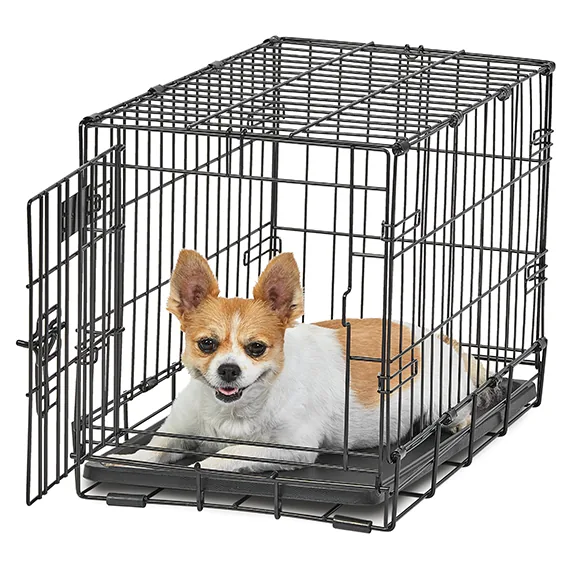
For everyday home use, your dog should be able to stand without crouching, turn around, and lie down stretched out. AKC guidance is explicit that an oversized crate can encourage eliminating in one corner and sleeping in another. That is why dividers exist on many wire crates: you want adult room eventually, but not a mansion on week one of house-training.
How to measure (home crates)
Have the dog stand naturally. Use a soft tape.
- Length: tip of the nose to the base of the tail (not the tip of a long plume). Add about 2–4 inches.
- Height: floor to the top of the head or ear tips, whichever is taller. Add about 2–4 inches.
Those add-ons show up across AKC-style advice and retailer measuring guides (for example PetSmart’s crate size chart). If you land between catalog sizes, size up. Round up, never down.
Breed-and-weight charts are a starting guess. A deep-chested 40 lb dog and a long-backed 40 lb dog do not need the same internal length. Measure.
Rough size bands (starting point only)
Retail charts often group by weight. Treat these as starting bands, then verify with your tape:
| Band | Typical weight | Typical length |
|---|---|---|
| XS | under ~10 lb | ~18–22 in |
| S | ~11–25 lb | ~24–30 in |
| M | ~26–40 lb | ~30–36 in |
| L | ~41–70 lb | ~36–42 in |
| XL | ~71–90 lb | ~42–48 in |
| XXL | ~91+ lb | ~48–54+ in |
A Labrador and a tall sighthound of similar weight can disagree with that table. Your measurements win.
Puppies: buy for adult size, divide the space
Expect adult length and height from the breeder, a growth chart for the breed mix, or your veterinarian — then buy a crate that will fit the adult and use a divider while the puppy is small. Buying three crates as they grow is expensive and unnecessary for most households.
Soft-sided, wire, and hard-sided are not the same job
- Wire / collapsible metal: common for house-training, visibility, dividers.
- Hard plastic / travel kennels: impact resistance, airline paths, car travel.
- Soft-sided: convenience for calm, crate-trained dogs — not a substitute for escape-proof containment for a digger or a panic chewer.
Our puppy crates ranking compares real kennels we researched for build and use cases. This guide is about sizing; that page is about which models we scored.
Airline and IATA sizing is stricter
Home "sit, stand, lie down" is not the same as live-animal air transport rules. IATA Live Animals Regulations style guidance (widely summarized for pet parents) uses four measurements on a standing dog:
- A — nose to base of tail
- B — floor to elbow
- C — width across the shoulders (or widest point)
- D — floor to top of head or ear tips
Common minimum internal formulas you will see cited for a single dog:
- Length ≈ A + ½ B
- Width ≈ C × 2
- Height ≈ D (plus bedding thickness when the rule set requires it)
Snub-nosed breeds often need extra room under airline policies. Always check your airline’s current crate rules before you buy — carriers publish their own lists and may reject a kennel that looked fine for the living room. Round up to the next commercial travel size.
Between sizes, anxiety, and "just get a bigger one"
Size up if you are between sizes. Do not jump two sizes "for growth" without a divider if you are still house-training — that recreates the bathroom-in-the-corner problem AKC warns about.
A dog that panics in a crate needs a training and welfare plan, not a larger crate as the only intervention. Extreme thrashing that injures the dog is an emergency / veterinary behavior conversation.
Criteria we use when we rank crates
- Internal dimensions you can verify against your tape.
- Door and latch hardware that survives daily use.
- Divider availability for puppies.
- Escape resistance appropriate to the dog (high-anxiety kennels vs soft carriers).
- Honest weight and airline notes — not a lifestyle photo.
Disclosure
We may be paid by companies we feature. This may influence rankings. Product cards below point at crates we already researched in our puppy-crates ranking. We did not invent veterinary endorsements.
Sources
AKC crate selection guidance; retailer measuring charts (PetSmart and similar); public summaries of IATA-style A/B/C/D kennel formulas for air travel. Always re-check airline pages before a flight.
More Picks We Love
The six U.S. pet insurers we have verified from public policy pages — not a guessed list.
Frequently Asked Questions
Should I size up if I am between sizes?▾
Yes for home crates. Round up. Use a divider for puppies so the space is not a bathroom wing.
Is a weight chart enough?▾
No. Weight bands are a starting point. Measure nose-to-tail base and standing height.
Do airline crates use the same math?▾
No. IATA-style guidance uses A/B/C/D measurements and stricter internal minimums. Check your airline.
Are you veterinarians?▾
No. We are the editorial team. Medical or severe anxiety issues need a clinic or qualified behavior help.
Where are the ranked crates?▾
Our puppy crates ranking lists researched models. This article is the measuring guide.
Want the rest of our research?
Browse Pet Standings hubs for dogs, cats, food, and health. We only publish ranked product cards when we have verified the items.
See ranked puppy crates →